

By Page H. Gifford
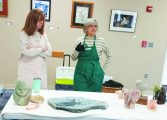
Artist Tom Tartaglino demonstrated how to unlock the secrets of perspective and foreshortening during the Fluvanna Art Association’s monthly meeting on July 21.
Many artists in the room were self-taught and had learned perspective through online videos, while others were art teachers with formal training. Students today often learn one- and two-point perspective as early as fifth or sixth grade. But many of those attending the program likely did not encounter it in school 40 or 50 years ago until high school or even college—if they pursued art seriously.
What seems complex to some is actually a foundation of good drawing and an essential skill for becoming a better artist.
Tartaglino was a late bloomer as an artist, although he grew up around art and painted during his youth. He was nearly 40 when he earned his Bachelor of Fine Arts degree from Virginia Commonwealth University. His philosophy is to learn the fundamentals, practice, make mistakes and then break some rules.
“Art school gave me helpful hints. My inspiration for a work of art usually happens while observing a scene many times,” he once said.
Repeatedly observing a scene is part of how Tartaglino interprets perspective. He has the gift of seeing like an artist, much as a musician has an ear for music. For some, it comes naturally. Others struggle because they have not yet trained themselves to see.
“Through close observation, I concentrate on the details that make it realistic and truthful,” he said. “When complete, it will be about something beyond the scene. It will have a depiction of a physical person or place, but carry a mood we all identify with.”
He showed members examples of his work while explaining how he approached his subjects, including the lighthouse at Ocracoke Island.
“I didn’t approach the lighthouse in the usual way,” he said. “I painted it in the distance with cottages in the foreground. I wanted it to be part of the community.”
He also showed paintings of buildings he had seen in the West, explaining how he interpreted their angles through observation rather than precise measurement.
Although best known for his paintings, Tartaglino also showed a bust of his father that was so lifelike that members immediately noted the family resemblance.
He discussed foreshortening in drawings of humans and animals and demonstrated the concept by looking at a branch head-on. He also showed how foreshortening is used when drawing boats.
“When it comes to perspective, wing it; otherwise, using rulers can make it look mechanical,” he said. “Do not follow mechanical means.”
He emphasized that training the eyes to see—and practicing—is the best way to master perspective.
Creating art requires diligence and patience, but those who are still learning often become judgmental about their work and whether it measures up to what they perceive as the standards of good art. Skilled artists recognize when something does not look right and continue changing it. That is part of the process.
“If we have a vision of our finished product and that guides us, then keep looking and changing it until you get it right,” Tartaglino said.
Part of getting it right is quieting the mind, becoming immersed in a meditative state and focusing on what is in front of us: the lines, angles and horizon.
“When we are painting, we are in the moment with our thoughts,” he said.
Members often ask what they should do with pieces that do not work out. Tartaglino paints on canvas and wood, primarily in oils. He can wipe away areas or cover mistakes with gesso. With paintings on wood, he sometimes uses a belt sander. The process leaves behind interesting colors that he can incorporate into another subject.
“I knew an artist who took out his canvases, threw them on a pile and lit them on fire,” he