

By Page H. Gifford
Art journaling has a long history. Leonardo da Vinci created illustrated scientific notebooks on anatomy and perspective in the 1500s. During the Victorian age, women spent their time creating memories in scrapbooks by elaborately layering pressed flowers, paper, and sentimental objects. Twentieth-century artists like Frida Kahlo used personal diaries for symbolic, emotional imagery.
Today, art journaling is on the rise once again, driven by mixed-media communities, altered books, and online platforms. The craft offers an artistic outlet without pressure, perfection, or selling.
Former art teacher and artist Alyce Walcavich demonstrated how to make a personalized journal at the Fluvanna Art Association’s monthly members’ meeting on Aug. 18.
Walcavich had put together the inner parts of the small journals, called signatures, with a variety of paper, from simple copy paper to colorful or patterned scrapbook papers. Members had fun putting together their outside pieces, choosing papers for the front and back covers and finishing their first journal from scratch.
She displayed many different types of small journals, including a beautiful and impressive Japanese one with fancy inserted bookmarks and different stitching. Other covers had embossed foils with paint.
The challenge for those used to painting a picture, framing it, and having an audience look at it was understanding the purpose.
For artists like Walcavich, it was seeing the evolution of her self-expression through ideas and techniques over time. Art journaling serves as a laboratory for trying new ideas without the pressure of a finished masterpiece and can also be used as a daily creative habit to reduce stress and process complex emotions.
Ideas and materials can come from anywhere. Repurposing old books, brown paper bags, and found vintage ephemera are part of the process.
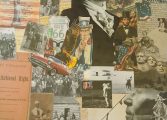
Art journals can come in many forms. “Glue books” are devoted entirely to collage, with compositions made from cutout images and text. Altered books are created by painting and designing directly on the pages of discarded hardback books. Mixed-media journals combine materials such as acrylic paint, ink, stamps, and handwritten text on heavy paper. Artists can also decorate the covers and pages of large, insert-free scrapbooks and use them for a variety of mixed-media projects.
Best of all, art journaling requires little investment and is accessible to beginners and seasoned artists alike.